


Most complaints concerning hardwood flooring are related to changes in the moisture content of
flooring and surrounding wood products. When moisture changes are severe, the result can be gaps between
strips, cupping, buckling, movement, and/or cracks/splits in the flooring. A combination of these
results may be present in the same floor.
The enclosed information and comments should help
explain some causes of shrinking and swelling and some of the possible results.
Knowledge of the
following items is necessary to assure the proper performance of flooring:
(1) the expected
moisture content of wood flooring in a particular area after acclimation;
(2) the moisture
content of flooring both at time of delivery and installation;
(3) the moisture content of
flooring system and moisture conditions at the jobsite;
(4) and additional factors which
contribute to the changing moisture content of wood flooring, such as the type and operation of HVAC
system, incomplete construction such as masonry, drywall, and time of year.
SHRINKAGE –
EXPANSION
Wood is a hygroscopic material. This means that when wood is exposed to air, it
will dry or pick up moisture until it is in equilibrium with the humidity and temperature of the air.
Moisture absorption causes wood to swell. Moisture loss causes wood to shrink. Shrinkage of wood begins
at 25-30% moisture content, the fiber saturation point, and continues until wood reaches 0% moisture
content, an oven dry state. Conversely, swelling occurs as wood increases in moisture content from 0% to
25-30% moisture content, the fiber saturation point. Above 25% – 30% wood is dimensionally
stable.
Wood does not shrink or swell equally in all directions. A change in moisture content of
a wood piece from 0% to 28% (oven dry to fiber saturation point) will increase the size of the piece
approximately 0.1% longitudinally or along the length/grain, 2% to 8% perpendicular to the annular
growth rings (radially or in strip width for quarter sawn flooring), and 5% to 15% change in size
parallel to the tree’s annular growth rings (also known as tangentially or in width of the strip with
plain sawn flooring). The expected change in size with a stated change in moisture content can be
predicted using the following formula:
____________________________________________
= %
Change in Dimension in Inches
Table 1 lists the coefficients for dimensional change for the
different hardwood species commonly used in flooring separated for plainsawn and quartersawn grain
directions.
Table 1: Coefficients for Dimensional Change*
- (% Change in MC%)
- x (Coefficient for Dimensional Change for the Species)
- x (Width of Piece in Inches)
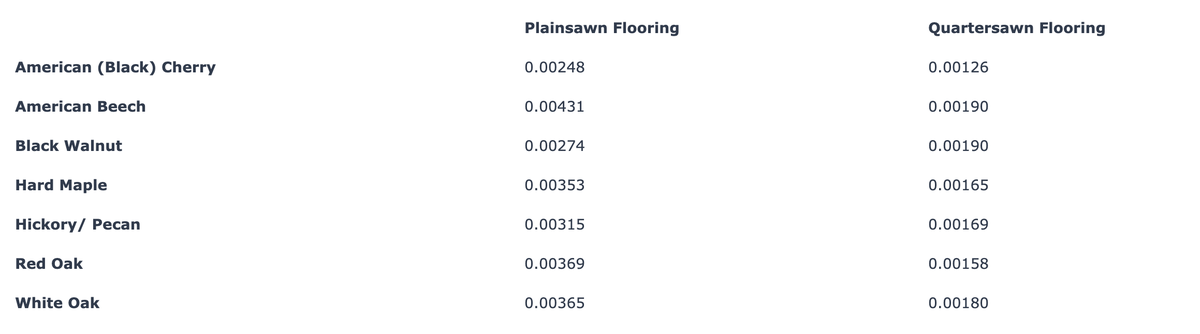
*From the Wood Handbook: Wood as an Engineering Material, 1999, the Forest Products
Laboratory, USDA Forest Service.
The following examples illustrate the different
influences of varying changes in moisture content, grain direction, species and width on shrinking and
expansion of wood.
Example 1: Differing Changes in Moisture Content. Using the
formula, one can see that the larger the change in moisture content, the larger the change in width of
the flooring piece between oven dry (0%) and the fiber saturation point (28%). A plainsawn, ¾” x 2 ¼”,
red oak strip may change in width by as much as:
0.0166” for a 2% change in MC%
0.0332”
for a 4% change in MC%
0.0498” for a 6% change in MC%
(4% change in MC%) x (0.00369) x
(2.25”) = 0.0332” change in width
Example 2: Grain Direction. As shown in example 1,
if a plainsawn, ¾” x 2 ¼”, red oak strip changes in moisture content by 4%, the width may change by
0.0332”. If a quartersawn, ¾” x 2 ¼”, red oak strip changes in moisture content by 4%, the width may
change by as much as 0.0142”: about half the expansion as with plainsawn flooring.
(4% change in
MC%) x (0.00158) x (2.25”) = 0.0142” change in width
Example 3: Width. Wider pieces of
flooring will shrink or expand more than narrow pieces of flooring for a given change in moisture
content. As shown in example 1, a plainsawn, ¾” x 2 ¼”, red oak strip will change in width by 0.0332” if
the moisture content changes by 4%. If a plainsawn, ¾” x 5”, red oak plank changes in moisture content
by 4%, the change in width may be as much as 0.0738”, which is more than twice that found with 2 ¼” wide
red oak.
(4% change in MC%) x (0.00369) x (5”) = 0.0738” change in width
Example
4: Species. Some species are less stable than others and will shrink or expand more than
other species. As shown in example 1, plainsawn, ¾” x 2 ¼”, red oak strip flooring may change in width
by 0.0332” if its moisture content changes by 4%. In comparison, a piece of plainsawn, ¾” x 2 ¼”,
American beech, may change in width by as much as 0.0388” for a 4% change in moisture
content.
(4% change in MC%) x (0.00431) x (2.25”) = 0.0388” change in width
EQUILIBRIUM
MOISTURE CONTENT
The moisture content of wood below the fiber saturation point is a
function of both relative humidity and temperature of the surrounding air. Wood will absorb moisture
from its environment or lose moisture to its environment until the wood reaches a point of equilibrium.
The equilibrium moisture content (EMC) is defined as the moisture content at which the wood is neither
gaining nor losing moisture; equilibrium condition has been reached. The relationship between EMC,
relative humidity, and temperature is shown in table 2.
Wood in service usually is exposed to
both long-term (seasonal) and short-term (daily) changes in the relative humidity and temperature of the
surrounding air. Thus, wood virtually always is undergoing at least slight changes in moisture content.
These changes usually are gradual, and short-term fluctuations tend to influence only the wood surface.
Table 2 shows average wood EMC at various levels of relative humidity and temperature. It can be used as
a basis for predicting the influence of the immediate environment on wood products, including wood
flooring.
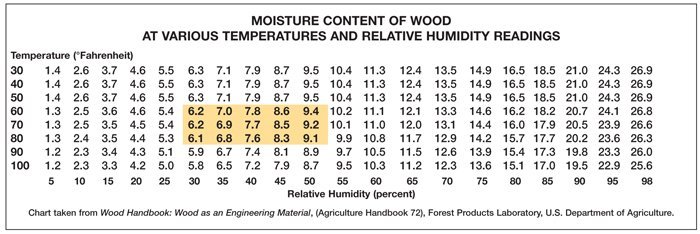
Table 2: Moisture content of wood in equilibrium with stated dry-bulb temperature and
relative humidity.*
Moisture content changes may be retarded, but not prevented, by
protective coatings, such as sealers, polyurethanes or paint. The practical objective of all wood
seasoning, handling, and storing methods should be to minimize moisture content changes in wood in
service. Favored procedures are those that bring the wood to a moisture content corresponding to the
average atmospheric conditions to which it will be exposed.
The Moisture Content Map shows
average interior moisture contents in winter and summer by geographic areas. In each pair of figures,
the first is average moisture content during January and the second is average moisture content during
July for wood products used indoors. For instance, flooring installed in buildings along the Gulf Coast
is expected to eventually acclimate between 11% and 13% moisture content. Also, flooring installed in
the Western Rockies can be expected to eventually acclimate between 4% and 8% moisture
content.
The moisture contents shown in the map are based on the average seasonal conditions.
Excessively dry or excessively wet conditions can further influence the changing moisture content of
flooring. Also Interior environmental controls that continually provide stable temperature and relative
humidity will reduce the change of MC% of flooring. Other influencing factors can be excessively wet or
excessively dry materials in contact with the wood flooring both during distribution and at the job
site.
For example, if a plainsawn, 3/4″ x 2 1/4″ oak strip is exposed to an environment which
increases its moisture content by 4%, i.e. from 7% to 11%, the strip may swell as much as 1/32” . The
opposite is also true, if a 2 1/4″ oak strip begins at 11% moisture content and loses moisture to 7%
moisture content, the strip may shrink as much as 1/32″.
Remember,Hardwood Flooring is
manufactured at 6%-9% moisture content with a 5% allowance outside this range. The jobsite conditions
will dictate the moisture content of wood products at equilibrium. If the job site conditions change
this range of moisture content, or the geographic area is expected to change this range, it is the
responsibility of those who handle and use the product to provide for and be informed of the eventual
expected changes.
Generally, wood flooring is expected to SHRINK in dry climates or when it is
exposed to dry conditions. Also, wood flooring is expected to EXPAND in the wetter climates or when it
is exposed to wet conditions.
The amount of shrinkage or expansion depends on your particular
area, how the wood flooring is handled, and individual construction practices.
COMMON
COMPLAINTS
One of the most common complaints with wood flooring is gaps between strips.
It is normal for the interior of homes to become dry during heating seasons, for obvious reasons. Under
this circumstance wood floors also dry out and shrink slightly. Properly made and properly installed
wood floors should be expected to have normal gaps, separations between edges of flooring pieces, in dry
months in most areas of North America. Depending on the width of the strips, boards or parquet members
used, the size of the room as well as the severity and duration of low outside temperatures (and hence
the intensity of heating), the term normal gaps can have various interpretations.
NORMAL
GAPS
Generally, gaps between strips are normal in strips 2-1/4″ wide or less if they
close up during the season associated with higher humidity, or the non-heating season.
Normal
gaps may vary in width from “hairline” gaps, thickness of stationary, to more significant gaps, up to or
greater than the thickness of a quarter. The larger gaps are expected in those geographical areas
associated with an extended dry heating season, and warm, mild humid summers that require little air
conditioning, i.e. the Great Lakes or New England area.
To further complicate gaps, plank or
strip floors sometimes “panelize” due to movement of underfloor construction. Also, normal wintertime
seasonal shrinkage may be concentrated into only a few gaps if the finish glues individual boards into
panels. Other joints between these larger gaps generally remain tight together. In this event some gaps
may be considerably wider than the thickness of a quarter, but still be considered normal if the gaps
close during the more humid season.
Plank floors, because of widths involved can shrink
individually up to 3+ times as much as 2-1/4” wide strip floors. Therefore, normal, seasonal gaps found
in those floors can be much larger than in a strip floor. Again, if the floor expands so that gaps
disappear during the humid non-heating season, they should be considered normal. For parquet floors
seasonal shrinkage and movement at ends of units may be quite noticeable. Also, the installation
procedures may leave gaps in the floor to maintain pattern lines. Therefore some permanent gaps in
parquet may be necessary. In addition, normal gaps between ¾” thick parquet units, installed in mastic,
can remain near perimeter walls if cork expansion joint filler is omitted.
JOB RELATED CAUSES
FOR GAPS
Large gaps in wood floors that do not close up in summer months can have either
job-related or manufacturing defects as the cause. Job site inspections should be designed to determine
which is the case.
When the complaint is gaps between flooring pieces, the moisture content of
flooring will normally be significantly lower than when the flooring was installed. The sub floor and
joists will also contain less moisture than when the flooring was installed. A very moist environment
and associated expansion about the time the flooring is installed may be the cause of gaps. As this
excess moisture is lost, shrinkage and movement of the flooring and underfloor materials
results.
Energy-conscious homebuyers have, in recent years, demanded building practices that
sometimes increase the moisture within a structure during the building process. Vapor retarders,
ostensibly made to prevent warm or cool air loss, may seal in the new home’s moisture. The excess
moisture may take far too long leaving the home thanks to vapor retarders. Literally hundreds of gallons
of water used in concrete (280 – 300 gallons per 10 cubic yards), masonry, thin-set tile mortar,
plaster, drywall joint compound, latex paint, and many other building components evaporate into the
home’s interior. Not only is this moisture absorbed by a wood flooring system, but also by other wood
materials in the home. This moisture will often cause wood flooring to expand before or soon after
installation. When this happens, the strips, planks or parquet units close on one another. The flooring
will move or reposition itself, and if the pressure is sufficient, cupping or buckling may result or the
flooring strips may crush against one another. Then, usually when the dry (or heating) season arrives,
the total moisture environment changes, and the flooring and underfloor structure will dry out. If the
earlier moisture absorption was great enough, the drying season will produce “abnormal” or permanent
gaps. From this point the gaps will probably never close completely in humid months if seasonal
environmental changes are normal.
One can identify abnormal versus normal gaps by determining the
proper fastening schedule as well as making proper observations, measurements and moisture content
readings of the flooring and underfloor materials.
For Example: Flooring moisture
content === 6% to 9% (average of readings)
Measurement characteristics=== Using the 2-1/4″ strip
as our example, it is difficult for a set of twenty 2-1/4 ” strips to span only 45″ due to slight
variations. The actual measurement may be 45” to 45 1/8″ slightly more or less.
If the flooring
was exposed to excess available moisture prior to installation, the flooring may absorb the moisture and
expand. Then, it may be too moist when installed and therefore oversized: the 20-strip span will be well
over the 45” to 45 1/8″ range. Once these expanded strips are installed and the environment is brought
to normal occupied conditions, the installed flooring strips will lose moisture to the drier environment
and shrink. Now the individual boards will measure very close to 2 1/4″ at 6 to 9% average moisture
content. The shrinkage back to the normal conditions will show up in gaps. If individual boards have
gone through an extreme moisture introduced expansion, their edges may have been crushed so their actual
width is perhaps slightly less, on average, than the original manufactured width.
Plank flooring
will have all the characteristics described for strip flooring except that under identical
circumstances, plank will exhibit more movement per board and hence larger gaps. Wide planks are also
more likely to be cupped with a slight amount of cupping considered normal.
Nailing: Nail
every 10″ -12″ with a MINIMUM of 2 nails per board within 1″ -3 ” of the ends.
Inadequate nail
spacing can also contribute to gaps. An inadequately nailed floor has more opportunity to move under
pressure. Since inadequately nailed flooring strips can more easily move to new locations, gaps are
likely to result from exposure of the flooring to high moisture conditions.
Squeaky floors are
another indication of floor movement after installation. Sufficient side movement will loosen nails
slightly, resulting in squeaks when foot traffic puts pressure on the floors.
MATERIAL-RELATED
CAUSES FOR GAPS
Another cause of abnormal gaps can be improperly manufactured wood
components. This usually occurs because lumber is not adequately dried before the flooring is
milled.
Flooring mills are operated to produce a product precisely milled to the intended width
(i.e. 2-1/4″) as the product exits the flooring machine. This is the case regardless of the moisture
content of the wood being processed.
If the moisture content of the wood is too high when
flooring is milled — generally in the range of 12% and above — the flooring will later shrink to the
range normal for its environment, usually 6% to 9% moisture content. In this situation, 2-1/4″ strips
will shrink more than 1/32″ in width leaving gaps between strips. These strips will be less than 2 1/4″
even during the humid season.
MEASUREMENT CHARACTERISTICS
The 45″ span used in our
earlier example may be very near that exact measure or even less than 45″. The key is the face width of
the boards within the set, some of which will be below the normal 2-1/4″ face width, as indicated
previously. The difference will be gaps between boards. As in the first assessment these principles
apply to plank flooring also, except that difference in width will be proportionately larger in relation
to the width of the planks used.
OTHER CAUSES FOR GAPS IN STRIP AND PLANK
FLOORS
There are several other reasons for gaps in floors, and these have little
relationship to job- site moisture problems. Some are:
System movement. When outside walls
settle — or the center supports under the house’s center beam move — the area of the floor actually
stretches, causing gaps over joints in plywood sub floors. This can be detected in foundation walls or
by checking the flatness of the floors.
Over-drying around forced air heating ducts
and vents. If gaps are associated with areas above heating plants, heating supply vents (particularly
closed vents) etc., check NOFMA “Installing Hardwood Flooring” for correct insulation
techniques.
Improper sub floor materials. Nail-holding capability is an imperative
consideration in floor installation. If the sub floor does not hold nails, gaps can occur from
less-than- abnormal moisture absorption or heavy traffic.
Subfloor Materials for –
Wood
Joist Construction === Either kiln dried boards of NO.1 or NO.2 Common Pine or other dense, Group 1
softwood, or exterior sheathing grade, performance rated ply-wood 5/8″ (18/32″) or ¾” (23/32″). Also, ¾”
(23/32”) OSB is comparable.
Concrete Slab Construction === ¾” or thicker sheathing grade
exterior plywood over the appropriate vapor retarder:
For ¾” T & G parquet installation over
joist construction === The primary sub floor as recommended for joist construction (see above) should be
overlaid with 1/4″ or thicker plywood (offsetting seams or installing the ¼” plywood on a diagonal) and
nailed in 4″ to 6″ grids to the subfloor.
Wood-fiber composition panels, commonly referred to as
fiberboard, wafer board, MDF, particle board, or others, are widely considered to be unsatisfactory sub
floors materials for solid tongue & groove hardwood flooring. These types of materials do not hold
fasteners well. Also, composition panels will expand from moisture absorption like most any wood
product, but do not shrink appreciably when the moisture dries out, leaving floors that are not flat.
Hardwood floors depend on lasting nail retention in the sub floor in order to perform well over the life
of a home –perhaps 100 years or more. Inadequate nail-holding characteristics should be avoided at all
costs.
Heavy vehicular movement, such as forklifts or trucks in public buildings,
factories and commercial buildings. Flooring systems designed for normal foot traffic often cannot
support heavy loadings without shifting.
ASSESSING CAUSES FOR GAPS –
PARQUET
Patterned floors. Parquets assembled from 3/4″ flooring are usually glued to the
subfloor with a mastic. If the subfloor is concrete, a vapor retarder is required under the flooring
(see Installing Hardwood Flooring). Absence of an adequate vapor retarder can result in moisture changes
with associated movement of the parquet pieces causing gaps.
For mastic-applied parquet, since no
piece is permanently anchored to the subfloor, the floor units move in no particular pattern when they
expand. Somewhere near the center of a room, however, one or two sections of the parquet pattern act as
the anchor, and all other pieces will move away from anchor points toward the walls. It’s for this
reason that cork is placed in the required perimeter expansion space to support the flooring at the
walls. This is a special cork with a very resilient binding resin, which acts as a compression spring.
It should be cut in small pieces to fit snugly between walls and each unit of parquet. If cork is not
used, permanent gaps near the walls of the room may develop. Since there is nothing to push the parquet
back as it dries during the heating season, these gaps will be larger than normal gaps in the center of
the room as seasonal drying occurs.
Good floor mastics allow slight movement of parquet units
without breaking the bond, and stretch somewhat under pressure. Some types will re-tack even after
breaking loose. If a large area of parquet units appear (or sound) loose, expansion has probably moved
the units too far for the mastic to retain its bond, or perhaps an inappropriate mastic was
used.
Parquet with abnormally large gaps during the heating season has no doubt gone through the
post-installation high-moisture cycle described earlier for nail-down products, and the proof is
established by moisture checks and measurements, much as described for strip or plank floors. Since many
parquet patterns alternate grain direction, movement will occur in all directions, but only 50% as much
as plank or strip in any direction. However, small gaps at ends of parquet units may be more noticeable
than the side gaps.
SOLUTIONS– GAPS BETWEEN BOARDS
Regardless of what moisture
environment a floor has been exposed to, or exists when inspected, removal and replacement of a wood
floor to alleviate gaps is usually both unnecessary and self-defeating. New flooring material is likely
to have a different moisture content than the flooring that is in place and already acclimated in the
home.
All parties involved are usually well advised to leave the offending floor in place and
make repairs if possible. Once an existing floor has been acclimated to a home’s environment, it is
likely to remain stable and, with professional repairs, can regain the appearance it had when new with
no loss of service.
NORMAL GAPS: If truly normal, in the sense the gaps close up in summer
months, no repairs are practical. Any filler used to fill up gaps when they appear — i.e., when the
floor is dry — will be pushed out as the wood expands when it picks up moisture. Also, these spaces are
necessary for humid season expansion and if filled can cause so much stress the flooring may buckle
after filling, or the wood edges may be crushed during the expansion cycle. Thus, fillers may cause
uglier gaps than those Mother Nature forced on the floors.
ABNORMAL GAPS: A professional flooring
contractor can properly repair floors that have gone through a very high period of moisture absorption
and then dried to leave abnormal gaps. After the proper repair is made, the gaps very nearly disappear.
In this case, it may be possible to properly fill any crack 3/32″ or less, depending on residue in the
crack, movement between pieces, and/or seasonal change.
In the process of expanding and
re-shrinking, grain direction in boards may play a role in the evenness of the resulting surface. Boards
with vertical (quartered) grain may become lower than adjacent flat-grain boards, thus requiring
re-sanding.
REPAIRING GAPS
After determining which gaps are abnormal, the time to
initiate repair is midway between the seasonal extremes of heating and cooling. For much of the USA this
would occur near the months of April or October.
First, the flooring should be assessed for
movement between strips. Strips may require face nailing particularly near the groove edge to eliminate
movement. (Face nail into the open grain of oak and ash so the nail holes, when filled, do not show. The
filler may be scratched with a utility knife to imitate grain to further camouflage the
hole.)
Next, thoroughly clean the gaps. Old filler and trash should be scraped and vacuumed
away.
Filler is next applied down into the gap to the tongue level. For latex filler in the wide
gaps, shrinkage of the filler may require more than one application.
After filling, coloring
(stains), screening, and recoating may follow where surface finish is applied. If refinishing the floor
is determined to be necessary at the mid-season inspection, filling should probably occur after required
face nailing and the first sanding cut. For waxed floors where wax has been embedded in gaps, even after
cleaning the filler may not adhere to the strip edges. Test an area first.
For the occasional gap
larger than 3/32″, most often traversing across the entire room and associated with an underfloor
support or subfloor panel edge, some options for repair include: replacing a run of flooring with
oversize strips; or taking up runs of flooring adjacent to the gap and reinstalling them tightly
together; or cutting an appropriate sized shim and gluing it into the gaps. If a great many gaps in a
small area (ie. 10’ x 10’) are close to 3/32” wide, then filling may not be the appropriate repair: more
extensive repair options used for gaps wider than 3/32” may be necessary. When properly repaired, gaps
are generally lost sight of and filler should remain in the gaps after repeated seasonal
changes.
Source: NOFMA: The Wood Flooring Manufacturers Association